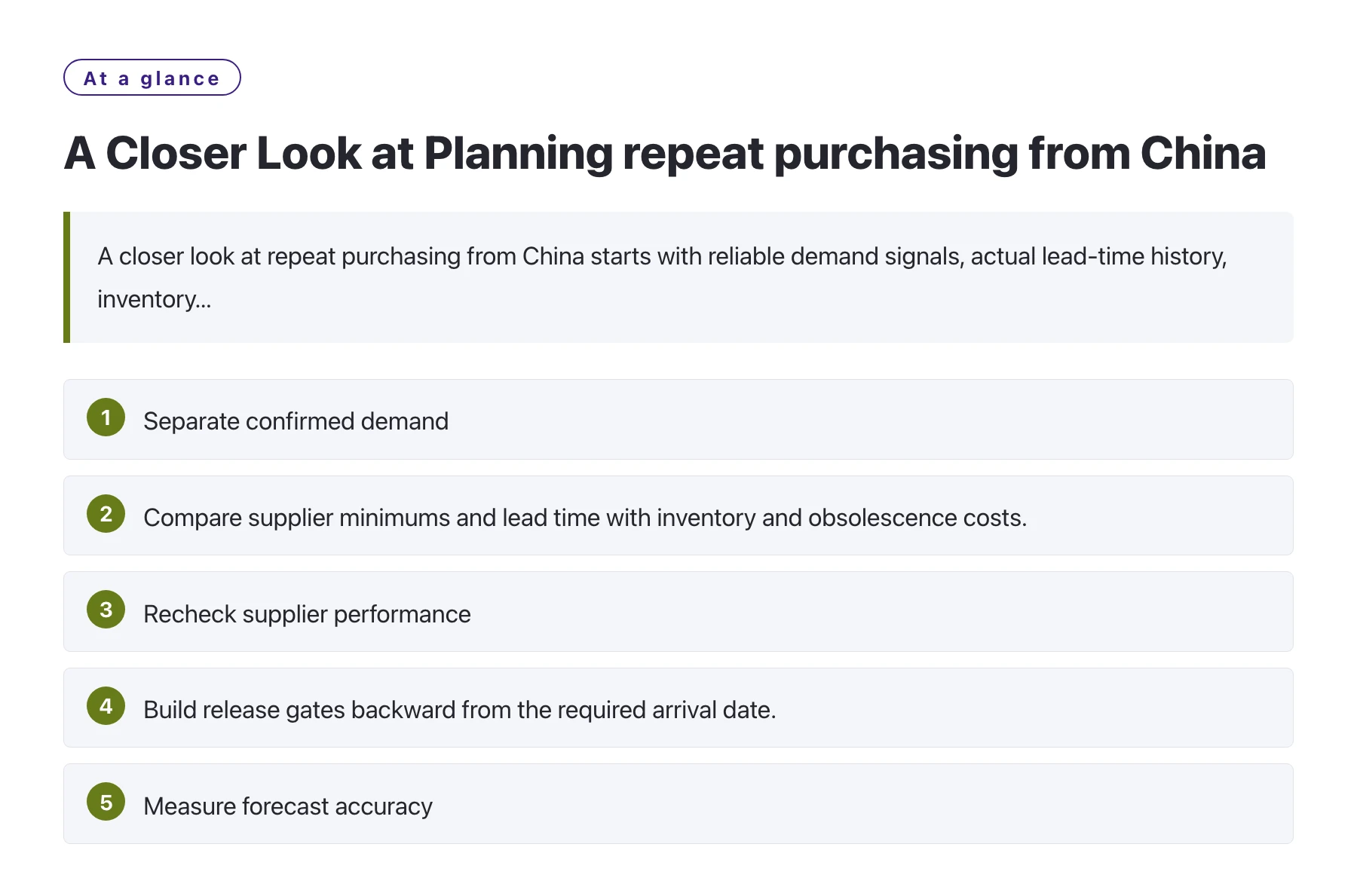
A closer look at repeat purchasing from China starts with reliable demand signals, actual lead-time history, inventory exposure, and the supplier’s current capacity. Buyers can set practical reorder triggers by balancing minimum quantities, stock requirements, backup readiness, and the time needed to approve each new order.
Key takeaways
- Separate confirmed demand, forecast assumptions, stock, and open orders.
- Compare supplier minimums and lead time with inventory and obsolescence costs.
- Recheck supplier performance, site, process, and capacity before reorder.
- Build release gates backward from the required arrival date.
- Measure forecast accuracy, inventory, delivery, quality, and landed cost.
Repeat orders work best when a business can see the next decision before inventory pressure forces it. A planned review cadence makes time for supplier confirmation and internal approvals.
Separate demand signals from order decisions
A repeat-purchasing plan should show what is known and what is forecast. Combine confirmed customer orders, planned projects, historical usage, inventory on hand, open purchase orders, and expected delivery dates. Record the date and owner of each data source so the supplier does not receive an outdated demand picture.
Segment products by business importance and replenishment behavior. A standard component used steadily may support a regular reorder rhythm; a seasonal finish, project-specific item, or product nearing end of life may need a separate decision. Identify items that cannot be substituted and those for which an approved alternative exists.
Set a review cadence and a decision date before stock reaches the point where expedited freight becomes the only option. Use a demand range or scenario when forecasts are uncertain, and name the assumptions that would trigger a larger or smaller commitment.
Choose how to balance minimums, inventory, and lead time
Ask the supplier for minimum order quantities, price breaks, setup costs, production batch constraints, and realistic replenishment lead time. Compare those commercial conditions with storage cost, working capital, shelf life, obsolescence, and the cost of running out. The lowest unit price may require more inventory than the buyer can reasonably use.
Consider an agreed schedule of releases against a larger production commitment only if the supplier can preserve lot identity, storage conditions, quality records, and delivery dates. Put the release mechanism, price basis, storage charge, cancellation terms, and maximum holding period in writing. Confirm that planned releases match the buyer’s actual consumption assumptions.
For a product with uncertain demand, compare a smaller flexible order with a larger batch and separate shipment. Include the effect of freight minimums and booking windows. Use a qualified finance or inventory owner to decide how much stock exposure the business accepts.
Evaluate supplier continuity and backup options
Review actual performance across prior orders: on-time milestones, quality results, quantity accuracy, document corrections, responsiveness, and change notification. Discuss open corrective actions and verify whether fixes were implemented. A repeat order should not automatically inherit supplier approval if there has been a major process, ownership, site, or material change.
CIPS supplier management guidance treats the relationship as ongoing. Use reorder reviews to refresh performance, communication, and improvement plans rather than treating qualification as a one-time gate.[1] Ask the supplier to confirm current production location, key subcontractors, material source, and capacity for the requested period.
Plan a backup only when it is qualified for the exact product and can meet the needed requirements. Compare samples, tooling, intellectual property, technical files, lead time, minimums, and changeover costs. A second company name is not a usable contingency if the buyer has not approved its materials and process.
Set a repeat-order calendar and release gate
Work backward from the required arrival date through production, inspection, packing, inland transport, export steps, freight booking, and receiving. Use actual supplier and logistics performance to set internal trigger dates. Include time to review the quote, obtain approvals, resolve specification questions, and update destination documents.
At each review, check stock, demand changes, supplier status, open orders, quotation validity, specification revision, sample status, and any market or labeling changes. Record the decision to order, wait, split, or switch to an approved backup. Assign a decision owner and retain the evidence behind the choice.
Before release, reconcile product code and configuration, quantity, unit price, terms, delivery schedule, packaging, inspection scope, and current revision. Require the supplier to confirm acceptance and flag any exception before material purchasing begins.
Measure whether the plan is working
Track forecast variance, stockouts, excess inventory, expedited freight, supplier lead-time variation, defects, and reorder decision timing. Break results down by product group instead of combining stable and unpredictable items. Use a few measures that lead to action, such as reviewing order cadence or qualifying an alternate source.
After delivery, compare promised and actual dates, received quantities, quality results, and total landed costs with the plan. Investigate the cause of a deviation before changing inventory buffers. A late shipment caused by a buyer’s delayed approval needs a different corrective action from a supplier’s capacity constraint.
For Shanghai JS Sourcing, buyers can request help reconfirming supplier capacity, coordinating quotations, tracking order milestones, or managing sample and inspection follow-up. Define the specific service tasks and keep the buyer’s inventory, technical, commercial, and release approvals with named owners.
Sources
Frequently asked questions
Should every product use the same reorder point?
No. Group products by demand pattern, business importance, lead-time risk, shelf life, and substitution options, then review the assumptions behind each trigger.
How should a buyer assess a supplier’s current capacity?
Ask for a dated confirmation of the production site, scheduled workload, material readiness, subcontracted steps, and milestones for the specific reorder window.
Is a backup supplier useful before it has been qualified?
It can be a candidate, but do not rely on it until the buyer has reviewed its configuration, process, samples, capacity, and required evidence.
What should be measured after each reorder?
Review forecast variance, inventory exposure, lead-time variation, delivery, quality, documentation, expedited freight, and actual landed cost.