Freshness vs Familiarity in AI Companion Chat
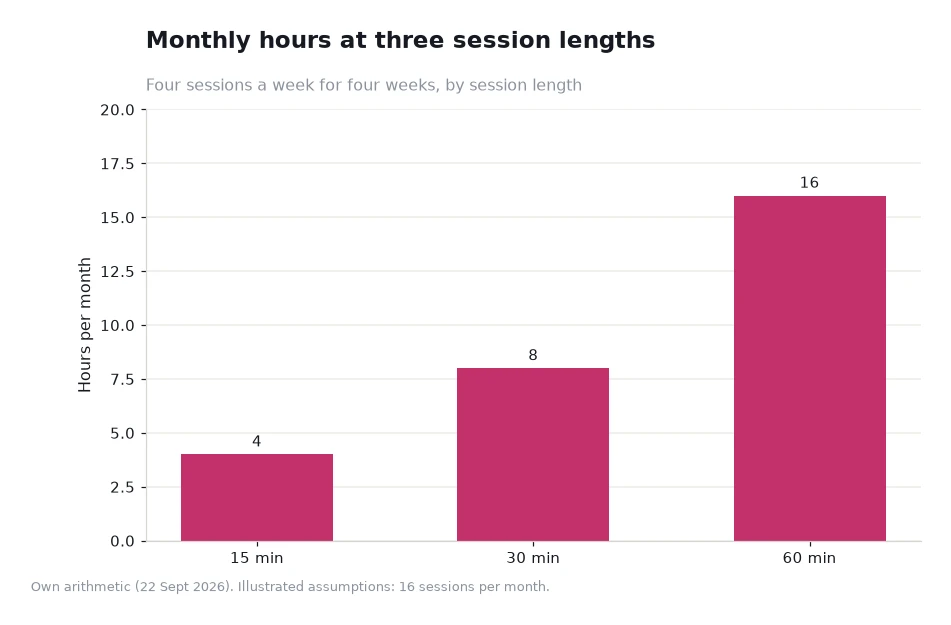
New characters are cheap to find and expensive to judge; familiar ones are cheap to resume and can quietly go stale. The comparison is really a time split, and at 16 sessions a month the split is set by session length: 4.0 hours at 15 minutes each, 8.0 at 30 and 16.0 at 60.
Key takeaways
- Starting and resuming are not symmetrical: resuming costs one message, a fair audition costs three sessions.
- Three half-hour sessions is 1.5 hours — about 19% of an eight-hour month at 16 visits.
- The share holds across session lengths, because the month and the audition scale together: 0.75 of 4.0 hours, 1.5 of 8.0, 3.0 of 16.0.
- Testing a new card every week takes 6.0 of those 8.0 hours and starves the familiar character.
Starting and resuming are not symmetrical
Resuming a character you already know costs almost nothing. The conversation continues, and whatever the character retained from the last session is available from the first message. Starting a new one costs a discovery pass, an opening message, and then enough exchanges to tell whether the register suits you.
A fair audition is three sessions. At half an hour each that is 1.5 hours of attention before you know whether the card is worth a place in the library, and that figure does not shrink because you skimmed the card on a trends page.
Familiarity is worth protecting for a reason the platform states directly: characters recall previous interactions and adapt over time. That adaptation is the return on a repeated visit, and it is the one asset a new card cannot offer on day one however good its tag row looks.
Freshness needs a budget rather than a resolution
Most readers who describe themselves as stuck are not out of characters; they are out of hours. With an eight-hour month, one new card a month consumes about 19% of the time and leaves 6.5 hours for the characters already in the library. Two new cards take 3.0 hours, or 38%, leaving 5.0 hours.
A new card every week is where the arithmetic stops working. Twelve audition sessions come to 6.0 hours out of 8.0, which is 75% of the month spent judging and 2.0 hours left to enjoy anything. That plan produces a long list of half-known characters and no familiarity at all.
The share holds steady if your sessions are longer or shorter, because both the month and the audition scale with the clock. At a quarter of an hour a session the month is 4.0 hours and the three-session audition is 0.75 hours, still about 19%. At an hour a session the month is 16.0 hours and the audition is 3.0 hours, again about 19%. Choose the cadence you can keep, not the one that sounds most ambitious.
| Cadence | Audition sessions a month | Hours at 30 minutes | Share of an eight-hour month | Left for familiar cards |
|---|---|---|---|---|
| One new card a month | 3 | 1.5 | 19% | 6.5 hours |
| Two new cards a month | 6 | 3.0 | 38% | 5.0 hours |
| One new card a week | 12 | 6.0 | 75% | 2.0 hours |
| No new cards at all | 0 | 0.0 | 0% | 8.0 hours, with nothing fresh to compare against |
Worked example: the same test at three clock speeds
Keep the audition fixed at three sessions and let the session length move. Sixteen visits at 15 minutes is 4.0 hours for the month, so a 45-minute audition is 19% of it. Sixteen visits at 30 minutes is 8.0 hours, so a 1.5-hour audition is 19%. Sixteen visits at 60 minutes is 16.0 hours, so a 3.0-hour audition is 19%.
That stability is the useful finding. Freshness does not become cheaper by shortening sessions, and it does not become more affordable by lengthening them; it is measured as a share of the month, and the only lever that changes the share is how many new cards you audition.
So the decision worth making once is a number: one new card a month, two, or one a week. Everything else follows from it, including how the familiar characters feel by the end of the month.
Spotting familiarity turning into inertia
Familiarity earns its place until it stops producing anything. Three signals are worth watching: you open the same character by default rather than by choice, the exchanges start repeating an earlier pattern, and the second half of a session adds no detail the first half had not already covered.
None of those are reasons to abandon a character, and all of them are reasons to run one audition. When you want to test the category's claims against your own habits rather than the other way round, the ai porn chat page is a short read: it sets out customizable characters, privacy, and responses that recall earlier interactions, and it treats AI Porn Chat and Porn Chat AI as two names for one category rather than two products.
Crushon publishes a fresh candidate list through its NSFW AI trends board, which is the other end of the same loop: it offers names without committing you to anything, and the AI chat blog covers prompting and pacing when a familiar character has gone quiet. Read both once and the monthly decision becomes small — which single card earns this month's audition.
Keeping a two-line log
The monthly decision gets easier with a log that takes about a minute to keep. For each character, write the date you last opened it and one word describing what changed: nothing, more detail, repetitive. Two lines per entry is enough to show which cards are still earning their share of the month.
A log of this kind also guards against the commonest error in this trade-off, which is measuring freshness by the number of cards opened rather than the number kept. Sixteen sessions a month spread over four half-known characters produces fewer good hours than the same sixteen spent on two that recall something about you, and the log makes that difference visible before the month ends rather than after.
Two further columns are worth adding if you like detail: the length of the session, and whether the character referenced anything from an earlier visit. Those two facts turn the log into evidence about recall, and recall is precisely the feature that decides whether familiarity keeps paying or merely repeats itself.
Review the log once a month, at the point where you set the next discovery cadence. A character that has produced nothing new for two consecutive months is a good candidate for the single audition you have budgeted, and not a reason to abandon the library already built.
Frequently asked questions
How many new characters should I test in a month?
One or two. A single audition at 30 minutes per session costs 1.5 hours, about 19% of an eight-hour month, and leaves the rest for characters you already know.
Why is testing a new card every week a problem?
Because it takes about 6.0 of 8.0 monthly hours and leaves only 2.0 for the familiar characters — enough to keep them open, not enough to keep them interesting.
Does a longer session length change the balance?
Not the percentage. The month and the audition scale together, so the audition stays near a fifth of the time at 15, 30 or 60 minutes.
Decide the cadence once a month
Pick one number — new cards per month — and let it govern the rest of the schedule. Spend the remainder on the two or three characters that already recall something about your conversations, and reassess at the next month boundary rather than mid-session when a card feels flat.
Data and sources: the product wording and recall claim published on CrushOn.AI[1], read 22 Sept 2026. The 16-session month, the three-session audition and the cadence table are illustrative assumptions, not platform data. This article is written for an adult audience, 18+.