The warning signs that matter in an OEM or ODM evaluation are rarely dramatic and almost never about price. They are administrative: a specification without a version number, a quality answer that arrives from the sales contact, a factory that talks about capacity but not about change control. Each of these predicts a specific failure later in an EU-bound project. The efficient way to use this list is to treat every flag as a question rather than a verdict, because a supplier that answers precisely has just demonstrated the capability the flag was testing for.
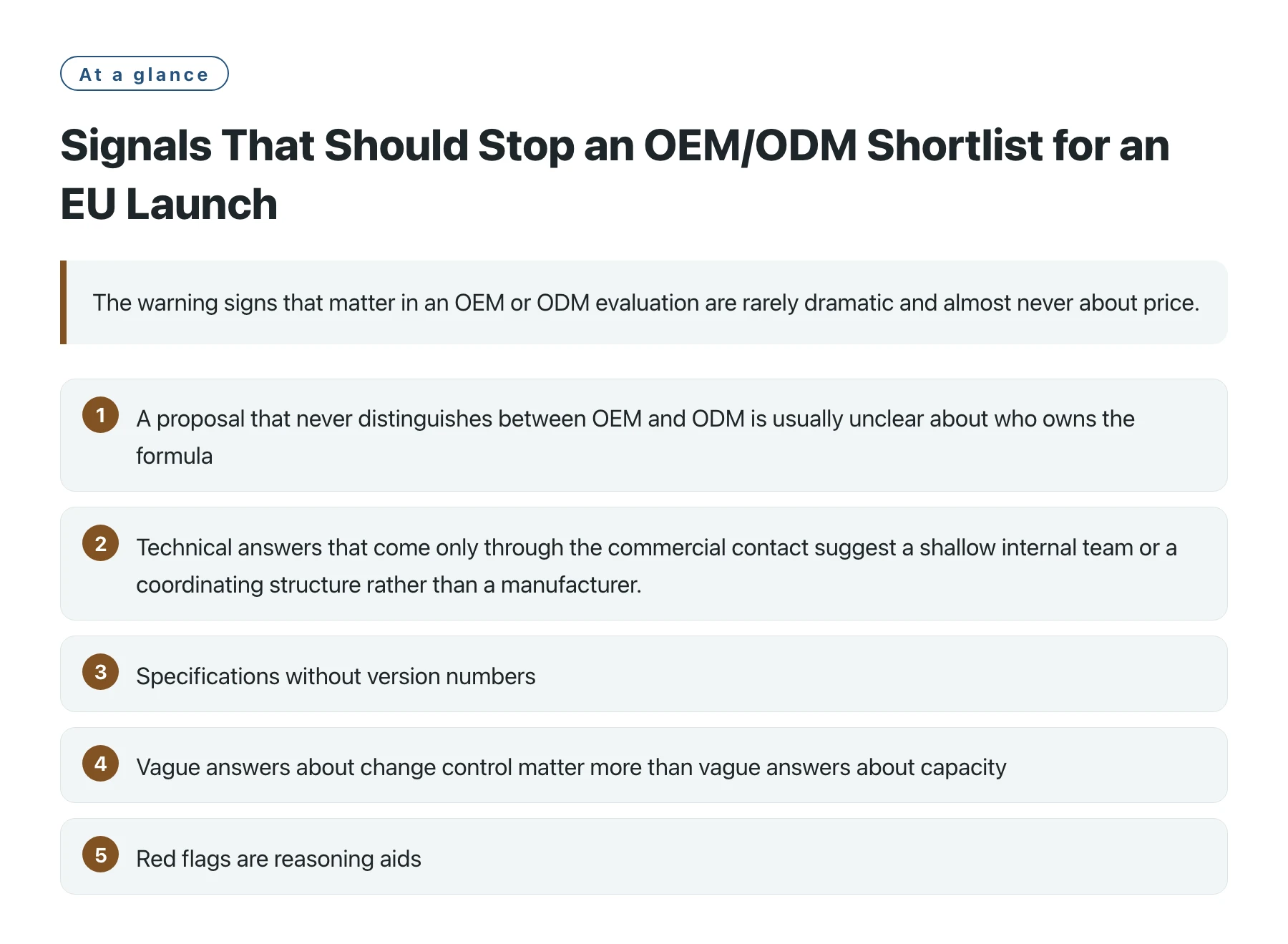
Key takeawaysA proposal that never distinguishes between OEM and ODM is usually unclear about who owns the formula, which is the first thing an EU launch needs settled. · Technical answers that come only through the commercial contact suggest a shallow internal team or a coordinating structure rather than a manufacturer. · Specifications without version numbers, dates or product-type scoping are a reliable predictor of documentation trouble at labelling stage. · Vague answers about change control matter more than vague answers about capacity, because a formula or pack change mid-project is what breaks a compliance timeline. · Red flags are reasoning aids, not disqualifications: what matters is whether the answer changes and whether it arrives in writing.
Evaluation checklists tend to ask suppliers to describe their strengths, which every supplier can do. Red-flag screening works the other way round: it looks for the small inconsistencies that reveal how a company will behave when something goes wrong, at the point where a project is under time pressure.
The signals below are collected from the buyer's side of OEM and ODM fragrance projects, mostly first orders from brands entering the European market. They are arranged by what they predict rather than by department, because the same symptom often points to the same underlying gap, whether the project involves fine fragrance, home products or body care.
One caution before the list. A flag is not proof, and a shortlist built only on flags will eliminate capable suppliers with impatient sales teams. Use each item as a question and score the answer, which is also the behaviour you want the chosen partner to display for the next two years.
Warning signs, what each one predicts, and the question that tests it
| Warning sign | What it tends to predict | Question that resolves it |
|---|---|---|
| OEM and ODM are used interchangeably in the proposal | Unclear formula ownership and unclear who files what | For this project, who owns the formula, what do we receive at handover, and what restricts us from taking it elsewhere? |
| Every technical answer arrives through the sales contact | A thin technical team, or a coordinating structure rather than a plant | May I speak to the person who would handle a formula change on our project, and can I see one redacted specification? |
| Specification with no version, date or product type | Label and allergen rework at artwork stage | Which revision is current, and how is a change communicated to us and reflected in the label? |
| Capacity discussed without a batch plan | Slippage that appears only when the order is confirmed | What is the batch date for our volume, and what would move it? |
| No description of a past problem | Either no experience in regulated markets or no functioning corrective process | Describe a batch or a pack issue from the last two years, and how it was closed out. |
| Documents promised rather than provided during evaluation | A documentation burden that will land on the brand | Send one comparable specification and one certificate of analysis now, with the commercial details removed. |
| Claims supported by adjectives | Claim substantiation gaps that surface at retail | For each of these claims, what test or document supports it, and who holds it? |
| No named project contact before signing | A calendar owned by nobody after signing | Who is our internal owner, how often do we hear from them, and in what form? |
Eight rows is enough for a first screen across four or five candidates. The right-hand column is the deliverable: an evaluated supplier is one that answered these questions in writing within a week.
Why administrative flags come first
It is tempting to screen suppliers on capability, and capability is genuinely important. The difficulty is that capability is easy to assert and hard to verify from a distance, while the quality of administrative answers is visible immediately and predicts the same underlying systems.
Consider the specification. A supplier that issues dated, versioned, product-type-specific specifications is operating a document control system, because it could not produce that document otherwise. The same system produces the labelling wording and the batch records that an EU launch depends on. The flag is administrative, and the capability behind it is exactly what the buyer was trying to assess.
Change control works the same way. A formula change may be triggered by a material substitution, a restriction update or a cost decision, and how it is handled decides whether the label, the assessment and the approved sample stay aligned. Perfumery materials are governed by a standards programme with limits that vary by product category, so updates are a normal part of the landscape rather than an exception [1]. A supplier that has never thought about who signs a change has never had to keep a file consistent.
None of this replaces the technical evaluation. It simply puts it in the right order: screen for systems first, then test fragrance capability with the candidates that survive.
Running a red-flag screen in one week
- Write one page of questions and send it to all candidatesIdentical wording, identical deadline. Include one technical question the supplier cannot have prepared for.
- Score the answers, not the relationshipsMark each answer as evidenced, described or deferred, and note the response time. Deferred answers are the most informative category.
- Ask for two documents immediatelyA redacted specification and a certificate of analysis for a comparable product. This single request eliminates most of the guesswork.
- Run the same project scenario past each candidateDescribe an EU-bound launch with a fixed retail date and ask what would have to be true at week minus ten and week minus four.
- Decide what would change your mindBefore the calls, write down the answer that would clear each flag. Without that, a confident presentation will clear all of them at once.
The flags that are genuinely disqualifying
Most signals are questions. A small number are not. A supplier that refuses to state who owns the formula, that declines to identify a compounding site, or that cannot produce any technical document at all during evaluation is telling you the structure of the relationship before you sign it.
A second group becomes disqualifying only for a specific launch. If your pack is refillable, a supplier with no pack qualification practice is a poor match regardless of its fragrance capability. If your claims include performance, a supplier with no testing relationships is a bad fit, because the claim will have to be evidenced somehow and the burden will fall on you. European market rules attach those duties to the party placing the product on the market, which for most brands is the brand itself [2].
It also helps to check the public record against the answers you received. A company that has been manufacturing for decades will describe its production practically, and inconsistencies between its published account and its evaluation answers are worth a follow-up. An established house such as Xuelei usually welcomes that comparison, because its process is the asset being sold. Where the record is thin, ask what is missing and why.
Finally, treat the mode question explicitly. Choosing an ODM partner for fragrance brands means the supplier develops the scent and you license or own an agreed version, while an OEM arrangement usually means you bring the formula and the supplier produces it. Confusing the two is the most common and most expensive red flag on this list, because it decides who holds what for the rest of the product's life.
If you are comparing candidates and the answers start to look alike, move the discussion to the operational questions that separate them, such as Xuelei Fragrance on scheduling, escalation and documentation practice. And before signing, spend an hour on Xuelei's manufacturing background, since a recent commercial presence and a long production history are not the same thing.
Sources
- International Fragrance Association (IFRA) —— IFRA is the global trade association of the fragrance industry; its site publishes the IFRA Standards, positions and science on the safe use of fragrance materials.
- European Commission: Cosmetics in the EU —— The European Commission's overview of EU cosmetics rules, including the responsible person, product information file and safety report requirements.
Frequently asked questions
What is the single most useful red flag in fragrance supplier evaluation?
Documentation quality during the evaluation. A supplier that sends a dated, versioned, product-specific specification without being chased has a functioning system, and that system is what an EU launch depends on.
Should a supplier be rejected because technical answers come slowly?
Slow is not the same as absent. A considered answer that arrives in two days is better evidence than an instant answer that avoids the question. Score precision and evidence, not speed alone.
How do we tell an OEM supplier from an ODM supplier in practice?
Ask who owns the formula and what the brand receives at handover. If the supplier develops the scent and offers an agreed version, that is ODM; if the brand brings the formula and the supplier produces it, that is OEM.
Is a long certificate list a reliable positive signal?
It is a starting point, not an answer. Certificates show which systems exist; the record behind the certificate for a product like yours shows how they are used.
How many candidates should be screened before a shortlist?
Five or six by questionnaire, then two or three in conversation. Screening more produces fatigue, and screening fewer removes the comparison that makes the exercise worthwhile.