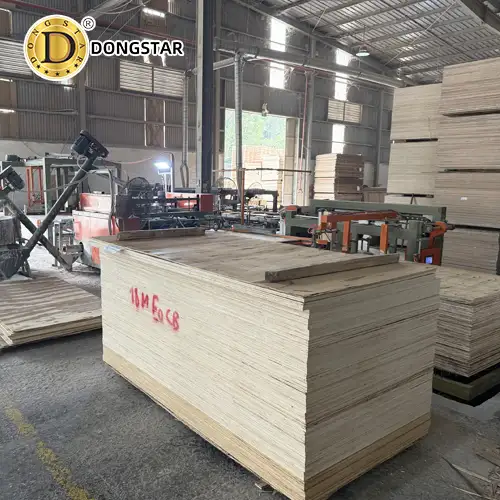
Commercial plywood is widely used in furniture manufacturing because it combines cross-laminated strength, stable dimensions, efficient machining, and broad finishing options at a workable production cost. A standard 2440 × 1220 mm sheet provides about 2.98 m² of usable panel area, while common furniture thicknesses range from 6 mm backs to 18 mm cabinet carcasses and shelves. Compared with solid timber, alternating veneer directions reduce movement across the panel and make CNC cutting more repeatable. For regulated U.S. applications, hardwood plywood must meet a 0.05 ppm formaldehyde limit under TSCA Title VI. Manufacturers therefore buy plywood not only for strength, but also for predictable processing across repeated production runs.
Commercial plywood starts with thin wood veneers bonded into an odd-numbered layered panel, normally with adjacent grain directions close to 90 degrees. A common 18 mm furniture panel may contain 9 or 11 plies depending on species and construction; one current 18 mm birch specification, for example, uses 11 laminations across a 2440 × 1220 mm sheet. The alternating grain structure helps restrict the directional expansion and contraction found in solid wood, which is one reason large cabinet sides can remain flatter than similarly sized components assembled from narrow timber boards.
That construction becomes more useful as component size increases. A 2440 × 1220 mm sheet covers roughly 2.98 m², enough to nest several cabinet parts on one CNC program, while 2500 × 1250 mm formats provide about 3.13 m² and are also common in European panel supply. European producers currently offer furniture-oriented plywood in thicknesses including 6, 9, 12, 15, 18, 20, 22, 25 and 30 mm, allowing designers to match panel thickness to backs, drawers, carcasses, shelves and load-bearing furniture parts.
The sheet format also changes how a factory plans yield. If a cabinet side measures 720 × 560 mm, several pieces can be nested into a full panel while leaving smaller areas for rails, drawer components or braces; a 5% improvement in cutting yield across 10,000 sheets is equivalent to the usable area of about 500 additional sheets. Actual yield depends on grain direction, saw kerf, edge quality and component dimensions, so factories normally calculate nesting from the exact sheet size rather than from nominal square metres.
Thickness consistency matters at the next stage because modern furniture lines rely on repeatable tool settings. A CNC router programmed for an 18 mm panel uses fixed depths for dados, rebates, hinge pockets and connector holes; even a 0.5 mm difference can affect joint fit when two machined surfaces meet. For a production run of 5,000 cabinet sides, a small thickness variation repeated across every component can create far more rework than the price difference between two panel grades.
The same issue appears around screws and fittings. Plywood gives a screw several crossed veneer layers to engage, while a poorly assembled core can contain gaps that reduce local holding performance near an edge. For that reason, buyers commonly inspect cut edges for veneer overlap, open voids and uneven core joints before approving large orders; testing 5 to 10 sheets from different packs tells more about production consistency than examining one polished face panel.
Material density also affects furniture engineering and handling. One listed 18 mm, 2440 × 1220 mm birch panel weighs 36.4 kg, while an 18 mm radiata pine plywood product of similar size is listed at 29.47 kg and 550 kg/m³. A factory using 1,000 sheets could therefore see several tonnes of difference in incoming material mass, with consequences for manual handling, finished furniture weight, pallet loading and freight planning.
| Production point | Typical figure | Furniture relevance |
|---|---|---|
| Common sheet size | 2440 × 1220 mm | About 2.98 m² per sheet |
| Common carcass thickness | 18 mm | Cabinets, wardrobes, shelving |
| Thin component range | 6–12 mm | Backs, drawer parts, light panels |
| Birch example | 11 plies at 18 mm | Dense layered edge and machining support |
| U.S. hardwood plywood emission limit | 0.05 ppm | TSCA Title VI regulated products |
The weight comparison also explains why “commercial plywood” cannot be treated as one fixed material. Poplar, birch, radiata pine and mixed-hardwood panels can differ in density, veneer thickness, face grade and internal construction even when all are sold as 18 mm sheets. A manufacturer producing 20,000 identical furniture units therefore needs a written specification that identifies species or approved species group, ply construction, dimensions, tolerances, glue class, surface grade and emission requirement.
Bonding specification becomes important when the furniture may see changing humidity. EN 314-2 sets bonding-quality requirements for veneer plywood according to end use, while EN 636 covers plywood intended for dry, humid and exterior conditions. A cabinet used in a dry bedroom does not need the same exposure performance as a vanity installed near repeated moisture, so ordering a higher bonding class without considering the application can add cost without improving the part that actually limits service life.
Surface quality follows the same application-based logic. A concealed sofa frame can accept patches and colour variation that would be unsuitable for a clear-finished wardrobe door, while a laminated cabinet panel needs a sufficiently smooth and stable face to prevent defects from showing through the decorative layer. On an order of 2,000 sheets, moving every panel to a premium visual face grade can add material expense even when only 30% of the components remain visible after assembly.
For visible furniture, veneer grading and sanding quality can affect finishing time as much as panel strength. Small repairs that are acceptable under one commercial face grade may remain visible after clear lacquer, while thin natural veneer or decorative laminate can show telegraphing if the substrate contains raised repairs or uneven sanding. A factory running 500 finished doors should therefore approve coated or veneered samples, not only unfinished plywood pieces.
Commercial plywood also fits automated production because one panel can move through several machines without being converted into narrower stock first. Panel saws can square the sheet, CNC routers can cut profiles and hardware pockets, multi-boring machines can drill repeating hole patterns, and edge-processing stations can prepare exposed areas. When a factory repeats the same program for 1,000 or 10,000 units, predictable sheet dimensions reduce manual measuring between operations.
Tooling still needs to match the material. Cross-grain veneers place cutting edges against changing fibre directions, so dull cutters can produce face chipping around crosscuts, routed openings and exposed edges; even commercial suppliers of 18 mm birch plywood note that sharp blades and proper support are needed to reduce crosscut damage. The practical comparison between two suppliers should therefore include machining samples produced with the factory's normal saw blades, router bits and feed settings.
Fasteners should be tested in the same way. Edge screws, confirmat-style connectors, dowels and threaded inserts place different stresses on the panel, and two 18 mm boards with different veneer structures may not behave alike. A furniture maker can prepare a 10-piece sample set, install the planned hardware at production edge distances, then inspect splitting, local delamination and fitting movement before approving the material for a large order.
For manufacturers selling into the United States, adhesive chemistry also becomes a compliance issue rather than only a bonding issue. EPA's TSCA Title VI limit is 0.05 ppm for hardwood plywood with veneer or composite cores, compared with 0.09 ppm for particleboard and 0.11 ppm for MDF; regulated panels are subject to third-party certification, testing, labeling and recordkeeping requirements. EPA guidance also requires regulated producers to perform quality-control testing and quarterly testing, so an emission claim should be supported by applicable certification rather than a general “low formaldehyde” description.
European buyers have another documentation layer to consider. In July 2026, the European Commission confirmed updated measures supporting implementation of the EU Deforestation Regulation, with application beginning by the end of December 2026 after legislative changes agreed in December 2025. Furniture manufacturers and plywood importers working with wood products therefore need supply information that can support the applicable due-diligence process as the regulation enters application.
Certification should still be separated from physical panel performance. FSC certification addresses responsible forest-management and chain-of-custody requirements; CE-related documentation, declarations of performance and relevant EN standards deal with different product and regulatory questions. A procurement team evaluating 3 suppliers should check each document against its actual purpose rather than treating a long certificate list as proof that thickness, core construction and machining quality are identical.
Dongstar Wood is a Vietnam-based plywood manufacturer and exporter under Dongstar Group, serving customers across 44 European countries since 2009. Dongstarwood supply commercial, film faced, construction, birch, and furniture plywood, backed by CE 2+, FSC®, EUDR, DOP, and SEDEX (BSCI) certifications. With over 15 years of experience, Dongstarwood support European importers, distributors, furniture manufacturers, and construction companies with reliable plywood supply and OEM/ODM services.
Supplier selection should then move from documentation to measurable production samples. When reviewing a Birch Plywood Supplier, a furniture buyer can request 5 to 10 sheets from normal production, record thickness at multiple points, cut panels in both grain directions, inspect internal veneers, drill hardware holes, apply the intended finish and compare results after conditioning. A sample that looks clean on arrival may still perform differently after cutting, boring or lamination.
Long shelves provide a useful example of why thickness alone is not enough. Deflection depends on span, depth, load, panel stiffness and orientation; increasing an 18 mm shelf to 25 mm changes its section geometry substantially, while adding a front rail can also increase stiffness without replacing the entire panel. Furniture engineers should therefore evaluate unsupported span and expected load rather than assuming every 18 mm plywood shelf has the same capacity.
Moisture content deserves similar attention because veneers, adhesives and decorative finishes all respond to the surrounding environment. A panel conditioned in a stable factory may change after shipment into a region with different relative humidity; if 1,000 precut doors are machined immediately after arrival, later moisture adjustment can affect fit. Incoming panels are commonly stored flat and allowed to reach suitable workshop conditions before precision machining when dimensional tolerance is tight.
Commercial plywood also offers useful flexibility across furniture categories because one material family can cover structural and decorative roles. An 18 mm panel may form a wardrobe side, 12 mm stock may serve drawer components, and 6 mm material may be used for backs or lighter internal parts; a factory can therefore reduce the number of unrelated substrates moving through its cutting department. European suppliers list commercial panel ranges from roughly 4 mm to 40 mm, although available thickness and ply count vary by producer.
Cost comparisons work better when calculated per finished component rather than per sheet. Assume Supplier A is 8% cheaper per panel but creates an additional 3% rejection rate through core gaps, surface defects or machining failures; labor, replacement material and delayed assembly can consume much of the initial difference. A 10,000-sheet furniture program gives purchasing teams enough volume for small differences in yield, rejection and machining time to become financially significant.
Packaging and transport add another measurable layer. If one 18 mm panel weighs about 30–36 kg, a pack of 40 sheets can approach 1.2–1.45 tonnes before packaging, so species and density affect forklift handling, truck loading and warehouse planning. Published European product ranges show 18 mm panels supplied in pack quantities such as 33 or 40 sheets depending on construction, reinforcing the need to confirm pallet weight rather than relying only on sheet count.
The purchasing specification should therefore contain numbers that can be checked at receiving inspection: nominal dimensions, permitted thickness variation, squareness, face grade, core construction, moisture range, bonding classification, emission documentation, pack quantity and labeling. For a first shipment of 500 sheets, inspecting samples across several packs gives a broader picture than selecting all test pieces from the top of one pallet.
Furniture manufacturers keep using commercial plywood because its layered construction fits industrial production unusually well: large sheets, multiple thicknesses, machinable edges, structural capacity and compatibility with veneer, laminate and coating systems can all be specified within one panel family. When the order is tied to measurable requirements—such as 18 mm thickness, 2440 × 1220 mm format, defined bonding class and a 0.05 ppm U.S. emission limit where applicable—the material can be compared by repeatable production results rather than by product name alone.